The first time I lost money on a Magic: The Gathering trade, I'd been at the store for thirty minutes. A stranger slid a binder across the table, pointed at a card I didn't recognize, and named a number. I said yes too fast because I didn't want to look like I was stalling, and the trade ended up six dollars off in his favor. The lesson stuck. Most bad trades at Magic events have a boring cause. Somebody got rushed, or somebody didn't know what to look for. Both are fixable before you walk into the store.
TL;DR Quick Answers
magic the gathering mtg events etiquette
MTG event etiquette is the unwritten code that decides whether other players want to sit across from you again. The rules that matter most at any Magic event:
Ask before touching anyone else's cards. Binder, deck, graveyard, anything that isn't yours.
Shuffle your deck thoroughly and offer your opponent a cut.
Read your cards aloud so your opponent knows what they're playing against.
Don't slow-play or stall. Strategize on your own turn, not the clock.
Keep the chatter low during your opponent's turn. Mind games outside the cards are bad form.
Take rules disputes to a judge, not Google or the player at the next table.
Trade between rounds, never during a match.
Show up clean. Shower, deodorant, brushed teeth. You're sitting across from people for hours.
Win humbly, lose graciously, and shake hands either way.
The hobby is smaller than you think. Your reputation travels with you, especially when it comes to understanding proper magic the gathering mtg events etiquette.
Top Takeaways
Safe trading at MTG events comes down to a few simple habits: sleeve your cards, check the price, and treat the other player like a person you'll see again next week.
Most bad trades come down to a rushed player, not a dishonest one.
A pricing app on your phone is the biggest single upgrade to your trade game.
When in doubt, ask a judge. That's exactly what they're there for, and nobody at the store will think less of you for it.
Build Your Trade Kit Before You Leave Home
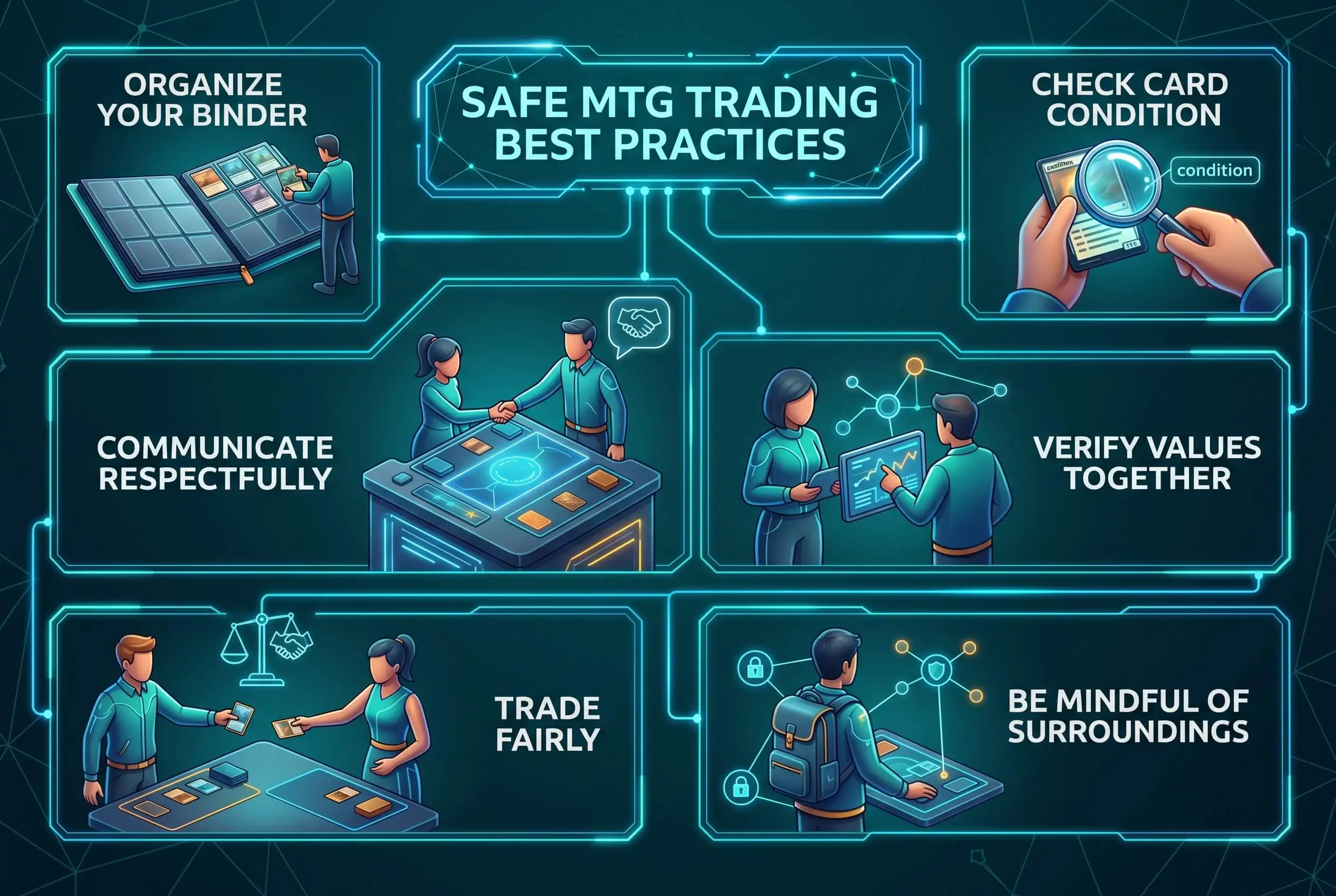
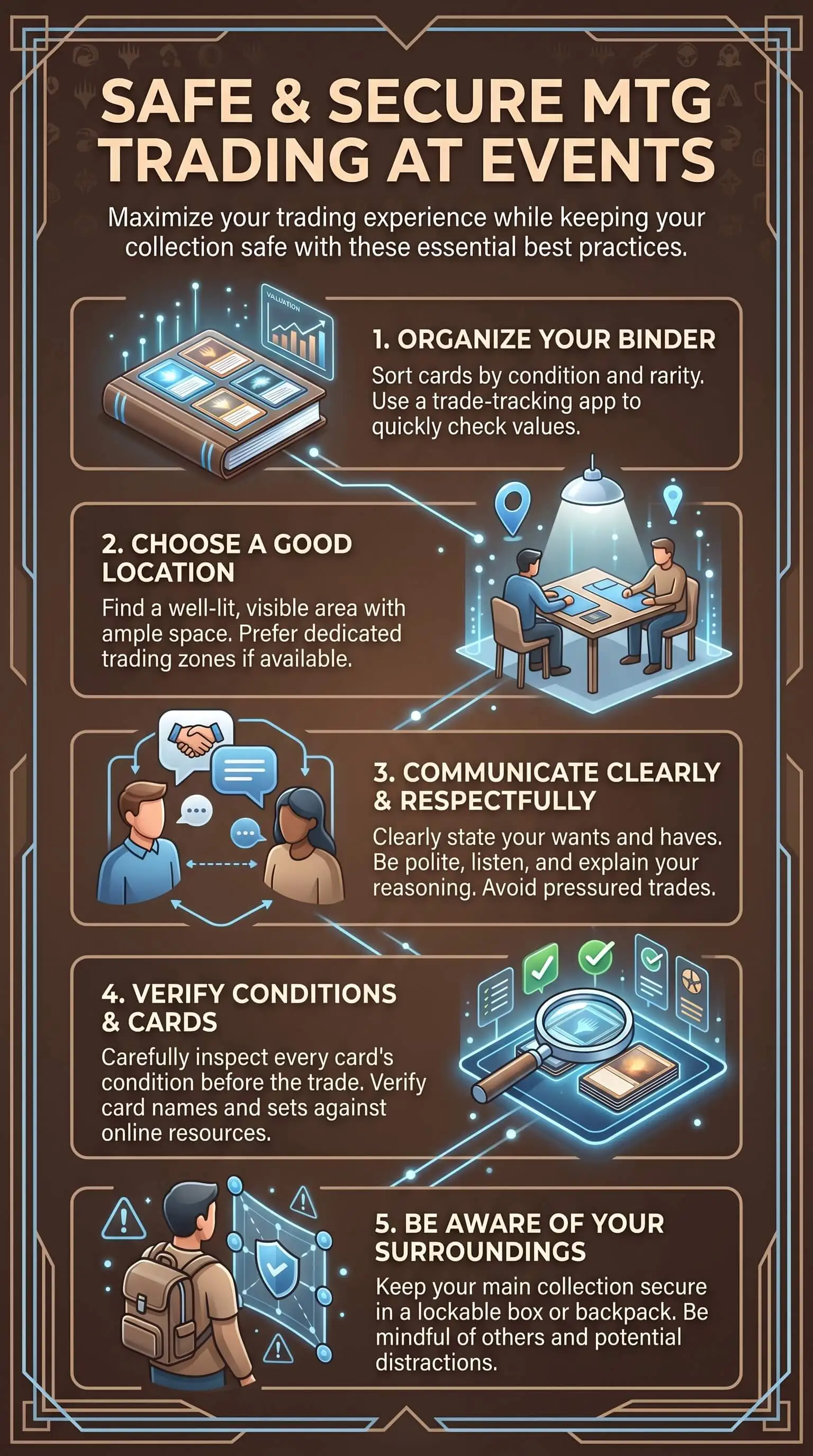
Most of the work that protects you at the table happens at home the night before. A real trade kit means a binder you've actually organized in some way that lets you find a card without leafing through forty pages, a phone you've charged, sleeves on anything worth more than a couple of dollars, and a pricing app already installed and signed in. Walking in with that setup tells other players you know what you're doing, which is half the battle.
For chase rares, double-sleeve them. Perfect-fit inner sleeve first, then a standard outer sleeve over it. It feels fussy the first time, much like when people first consult with a healthcare professional about preventative care. After your first close call with a dropped soda or a sticky table, you'll never travel without it again.
How to Evaluate a Trade in Real Time
When someone slides a binder toward you, slow down. There's no rule that says you have to answer in thirty seconds. Anyone pushing you to decide faster is the person you should be checking on hardest.
Start by handling each card under good light. Tilt it under the bulb. Look at the edges for whitening, the corners for softness, and the surface for scratches. Then sight down the length of the card for bend lines. Pull up live prices on Scryfall or TCGplayer for both sides of the trade. Read the numbers aloud. Agree on conditions out loud too: near mint, lightly played, moderately played. Both players saying the words means both players remember the same deal.
A fair trade doesn't always need to land within a few dollars either way. Sometimes you're trading a card you'll never play for one you're going to build a whole deck around, and that's worth paying a little extra for. The point is to know what you're giving up and what you're getting before you say yes.
Red Flags Worth Watching For
Most bad trades happen for boring reasons. A rushed player, a distracted moment, hesitation to look something up. Even so, a few patterns are worth pausing on.
Aggressive urgency is the loudest one. If the other player keeps mentioning they have to leave soon, slow down even more, not less. Watch out too for vague condition language, where a card gets called “near mint” while you can see whitening across the back. Someone who won't let you photograph a card before the trade closes is telling you something. So is an offer from a stranger that looks too generous for someone you've never seen at the store before. None of these are accusations on their own, just prompts to slow down and ask more questions.
Trade Etiquette That Protects Everyone
Trading well is partly about not getting ripped off and mostly about being someone other players want to trade with again next week. Ask before touching anyone else's cards. Handle them by the edges. Hand them back face-up the same way they came to you. And don't critique someone's binder or their deck choices, even as a joke. The hobby is small.
Don't trade during an active match, and don't let a negotiation spill into the space where someone else is playing. If a round is about to start, finish your conversation and pick it up after. For the broader picture of how to behave well at any tournament or casual night, MTG events player etiquette covers the rest of the social side.
When something goes wrong, find a judge or store staff. That's literally what they're there for.
“In a decade of judging at three different stores, I've watched hundreds of trades happen at tables. The ones that end badly almost always look the same. Somebody felt rushed. Slow down, sleeve up, check the price on your phone before you say yes. The players who do that don't end up at my table asking for a ruling later.”
7 Essential Resources
These are the references worth bookmarking before your next event.
Magic: The Gathering Tournament Rules. The official document from Wizards of the Coast covering conduct at sanctioned events. Updated several times a year, and the one your judge is working from.
Magic Judges Rules and Policy Resources. Where certified judges write up the deeper “why” behind the official rules. Useful when you want to understand a ruling rather than memorize it.
Scryfall. The Magic card database most players use to confirm version, set, and condition references with high-resolution images.
TCGplayer. The most widely accepted real-time pricing reference for North American trading.
Cardsphere. Peer-to-peer trading platform with structured haves and wants lists, useful when you want to trade outside your local store.
EDHREC. The site to check before you trade a card away if you think it might be in demand for Commander.
r/mtgfinance. Subreddit for price trends, reprint risk, and market commentary across the hobby.
3 Supporting Statistics
Magic crossed roughly 50 million players worldwide as of February 2023. In-person events have never been more crowded, which is good for trading and good for the small percentage of people you have to watch out for.
In Hasbro's 2022 fiscal year, Magic became their first billion-dollar brand. That number is one reason the secondary market now attracts real money rather than just hobbyist trades.
The most expensive Magic card ever sold was an Alpha Black Lotus that went for $3 million in a private sale in April 2024. Most cards crossing your table won't come close to that range. Some will. Know which is which before you say yes.
Final Thoughts and Opinion
None of this is about being suspicious of other players. Most of the trading community is great, and that's exactly why bad habits stand out when they happen. The trades I've seen go right at local game stores over the years come down to a few habits: sleeve what's worth sleeving, check the price before you say yes, and be the kind of player people remember favorably. The hobby is smaller than you think, and your reputation travels with you, much like how companies master brand strategy through consistency and trust. Do the work, and the secondary market becomes one of the most rewarding parts of Magic. The community polices itself, mostly. Good habits are what keep it that way.
Frequently Asked Questions
Is it safe to trade MTG cards at local game store events?
Yes, in most cases. Local game stores are the most common and most trusted place to trade. Bring sleeves, a pricing app, and the willingness to walk away from anything that feels rushed.
What apps should I use to check Magic card prices during a trade?
Scryfall and TCGplayer are the two most-used pricing references. Both are free and update continuously. For North American trading, TCGplayer market price is the benchmark most players go by.
Can I trade Magic cards during a sanctioned tournament?
Yes, between rounds, as long as it doesn't delay play. Trading during an active match is off-limits, and any conversation needs to wrap up before the next round is called.
What should I do if I think someone is trying to scam me on a trade?
Walk away politely. You're never obligated to finish a trade you don't feel good about. If something has already gone wrong, tell a judge or the store staff. They can document what happened and take it from there.
Is trading allowed at Commander pods, or is it considered rude?
Trading is fine before or after a Commander pod, just not during it. Commander runs on the social experience of the whole pod, and pulling out a binder mid-game pulls everyone out of the moment.
Call to Action
Take these habits with you the next time you head to an event, whether you prefer a magic gathering mtg digital life counter app vs physical options, and keep building on them. Trading well is a skill that compounds over time. The players who treat the table with care end up with the strongest collections and the longest friendships in the hobby.